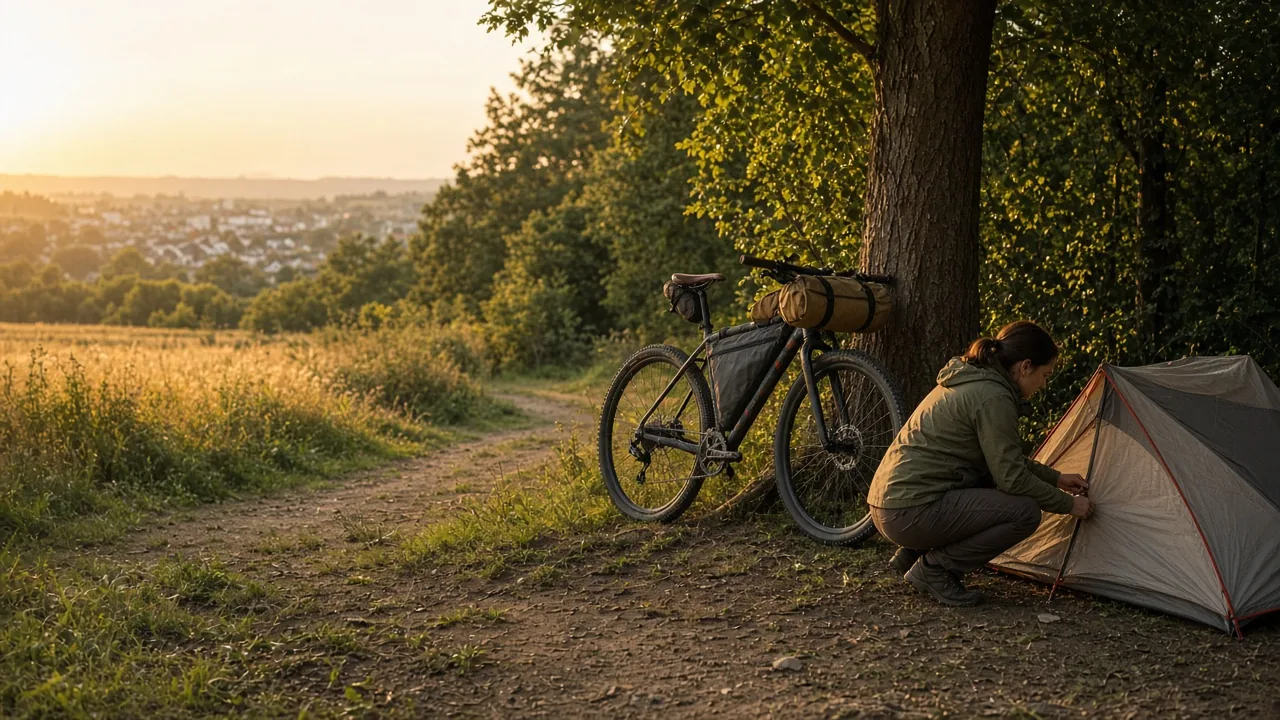
That's far enough to test your bags, your saddle, your water and a night in the tent, and short enough that a bad day is easy to recover from. Ride the bike you already have, wear clothes you've ridden in without chafing, set up camp in daylight, and make the next trip a little longer.
Your first bikepacking trip: start with about 15 miles
One woman in the group bought a used mountain bike and did what a lot of us would have told her not to: she rebuilt the brake and gear systems herself, bought a pair of Walmart shorts, and asked the group about etiquette before her first tour, a 15-mile one.
The group cheered her on. Not because her setup was impressive (though rebuilding your own drivetrain as a beginner genuinely is), but because she'd nailed the most important part of bikepacking: she'd decided to start, and she'd decided to start small.
Your first bikepacking trip doesn't need to be a week in the desert or a month across Europe. It needs to be a loop you could walk home from if everything went wrong. Grant Petersen's sub-24-hour overnight idea works the same way: stay close, set up in daylight, ride home in the morning. Fifteen miles is enough to teach you what actually matters: how your bags behave, whether your saddle works, how it feels to cook dinner next to your tent, and how much water you really drink.
The bike you have is the bike you ride
The group's veterans keep coming back to one piece of advice.
Women in the group: "I would definitely start with the bike you have, see if touring is for you, not everyone likes it, then upgrade."
Another woman loves her 1980s Trek 520 and wanted to make it work for gravel. Half the comments told her to change the tires and ride it; the other half warned that old frames can't always take modern gravel tires or replacement parts. Both halves were right, and that's the point: you learn your bike's limits by riding it, not by shopping for a different one.
So if your bike has two working wheels, working brakes, and gears that shift most of the time, it is a bikepacking bike. If you're on a smaller frame and wondering about wheels later, see which wheel size suits a shorter rider.
What to wear (without spending $400)
The Walmart shorts are the hero product of this article, and she isn't the only one keeping it cheap. The anti-gatekeeping current in the group is strong for a reason. A big barrier, judging by how often the group pushes back on it, is the idea that you need a specific kit list before you're allowed to begin.
For a first trip, start with what you already own:
- Shorts or leggings that don't chafe. Bike-specific padding is a comfort, not a requirement for one short trip. Cycling guides say padded shorts or a liner are the first piece of kit worth buying once rides run past 20–30 minutes, and a liner can go under shorts or leggings you already own (Pedal Primer; Cycling UK). Otherwise wear something you've ridden in without chafing.
- Layers, not techwear. A base layer, a mid layer, and something windproof covers most conditions. Merino tops and socks are the group's most consistent clothing recommendation.
- Real rain gear matters sooner than you think. Women in the group, on rain: "As they say, there's no bad weather. Just bad clothing. Ha. Seriously, get yourself a merino top and socks. And splurge on rain gear. I have the Cleverhood cape but there are many options." You probably won't face sideways rain on your first 15 miles, but the day you do, you'll understand her.
What to bring for 15 miles
Think overnight-hike amounts of gear strapped to a bike, not expedition amounts. Here's the full list of what to pack.
The basics: tent or bivy, sleeping bag and pad, a way to cook or food that needs no cooking, water and a way to carry enough of it, a headlamp, a basic repair kit (spare tube, pump, tire levers, multi-tool), and your phone with a way to charge it.
Food and water, the group way. The group's 50-comment nutrition thread, about fueling a first 65-mile day, scales down nicely:
- Women in the group: "Drink before you're thirsty (sip every 15 minutes) and eat before you're hungry (at least every hour, preferably 1/2 hour)."
- Women in the group: "If you're not peeing by the time you stop for lunch, you aren't drinking enough."
- Women in the group: "Powders and potions and gels are for athletes, not bike riders, imo. Normal food is best."
For a short, mild-weather ride, drinking to thirst is fine for most people; in heat, plan on more, about two bottles an hour, and don't overdrink (BikeRadar).
For 15 easy miles you're unlikely to need gels or sports drinks if you start with a good breakfast (Roadman). Bring normal food you like: sandwiches, fig bars, peanut butter anything, dates, trail mix.
Pack like it's a test. Because it is. Put your bags on the bike before you leave (even a cheap dry bag strapped to the handlebars works) and ride around the block loaded. Things rattle, slip, and rub in ways they never do in the living room.
Etiquette: what the group told a new rider
A new rider asked about etiquette before her first tour, and the question itself says something about this community: nobody assumed she should already know.
The short version, from how the group treats its own newcomers:
- Ride your own pace and don't apologize for it. A 24-year-old woman in the group, planning a ride from Portugal to the North Cape, put it this way: "For me, travelling by bike means being a traveller, not just a tourist. You move slower, experience places more deeply, meet people, discover new cultures and get to know your own limits." Another woman put it more simply: "Being a tourist is my excuse for travelling slow on my bike. You remember what you see really vivid because you travel that slow." Slow is not a beginner thing. Slow is a bikepacking thing.
- Ask for help. The culture in the Women’s Bikepacking & Bike Touring group is to help first. One woman got 33 comments of practical advice on mounting fork bags to her vintage Raleigh. Another got 34 on her old Trek. None of the comments we captured said "buy a new bike."
- Leave campsites better than you found them, and pack out everything you brought (Leave No Trace).
A word on sleeping outside
If the thought of sleeping in a tent makes you nervous, you're in big company. One woman asked the group about feeling safe in a tent on her first trip along the Portugal coast: "I feel very vulnerable sleeping in a tent. I'm planning to bring a padlock... I know I will be on edge as a solo woman." She got 63 comments back, one of the deepest threads in our research window, and the comments we captured were overwhelmingly kind, practical, and calming.
The advice that came up most from women in the group: don't lock yourself in (you need to get out fast), put a bell on the zipper so you hear it, bring a whistle and a headtorch, arrive in daylight, and camp near families, retired people, or other cyclists.
Solo-camping guides give the same basics: keep a whistle within reach, camp where others can see and hear you, and set up before sunset (Solo Sojourn Project).
This is community experience from women in the group, not professional safety advice.
Your first trip doesn't have to be solo. Bringing a friend is the easiest safety strategy there is, or tell someone your route and when you'll be back.
What to do with the other 364 days
The best part of a 15-mile first trip is what it unlocks: you stop being a person who "might try bikepacking" and become a person who has done it. From there, the group suggests small steps, not big leaps.
Women in the group, on beginners overthinking it: "Stop with the questions, and just cycle! The best answers are yours!"
On the second trip, make it 25 miles. On the third, try camping somewhere with no facilities. On the fourth, try a second night. Each trip teaches you one thing to change (a strap that slipped, a saddle that pinched, a snack that wasn't enough), and the change is small enough to make before the next one.
A 73-year-old woman in the group, on the practical stuff the rest of us overthink: "I'm 73, been squatting behind trees for 70 years." The scary parts get normal. The uncomfortable parts get managed. And the fun parts (dinner by the tent, the quiet road, the feeling of having carried everything you need) stay fun.
Your first 15 miles won't be perfect. Hers probably wasn't. But it's the trip that makes all the others possible.
FAQ
How far should a first overnight bikepacking trip be?
About 15 miles is a good first test. That is what one first-timer in our group rode, and it is short enough to pick a loop you could walk home from. Published overnighter routes usually run longer: BIKEPACKING.com says routes submitted to its Local Overnighter Project typically run 30 to 100 miles. So 15 miles is a deliberately easy start, not a rule. The sub-24-hour overnight idea works the same way: stay close, leave in time to set up in daylight, ride home in the morning.
How many miles should I ride per day when bikepacking?
It depends mostly on terrain. Exploring Wild's pace guide puts beginners at roughly 20–35 miles a day on pavement and smooth gravel, 15–30 on gravel and light singletrack, and 8–12 on technical singletrack. It also says beginners often tire after about 3–4 hours of riding. The guide's author calls these rough numbers.
What are the steps for a beginner to get started with bikepacking?
Use the bike you have. Strap on whatever bags you can (a dry bag on the handlebars works) and ride around the block loaded. Then do one short night close to home, or even a backyard test camp, and change one thing before the next trip. Pack from what to pack for your first night out.
What are some good bikepacking routes for beginners?
Start local: a state or regional park campground within an easy ride, on a loop or with an easy way back. BIKEPACKING.com's Local Overnighter Project maps community-submitted overnight routes.
What's a good beginner bike for a woman?
The one you already own, if it has working brakes, wheels and gears. Women in the group put it this way: "start with the bike you have, see if touring is for you... then upgrade." If you're shorter and choosing between wheel sizes later, see our wheel-size guide.
What the group says
- Women in the group: "I would definitely start with the bike you have, see if touring is for you, not everyone likes it, then upgrade."
- Women in the group: "Drink before you're thirsty (sip every 15 minutes) and eat before you're hungry (at least every hour, preferably 1/2 hour)."
- Women in the group: "Powders and potions and gels are for athletes, not bike riders, imo. Normal food is best."
- Women in the group: "Stop with the questions, and just cycle! The best answers are yours!"
- Women in the group: "I'm 73, been squatting behind trees for 70 years."
Source note
This piece draws on discussion in the Women’s Bikepacking & Bike Touring Facebook group (research window June 23 – September 20, 2026), including a first-timer thread about a 15-mile tour, a 50-comment fueling thread, a 63-comment tent-safety thread, and threads on vintage bikes and clothing. Quotes are from women in the group. Individual names are not used.
A note on methodology: comments were captured as visible at research time under Facebook's default "Most relevant" ordering. Small threads were captured fully; on threads with roughly 28–64 comments, generally the top ~10 visible comments were captured. Not every comment in every thread was captured.
Safety and health lines are community experience, not professional guidance.
Sources:
- Exploring Wild, bikepacking miles per day
- BIKEPACKING.com, Local Overnighter Project
- Grant Petersen, S24Os (Adventure Cycling)
- Bicycling, tips for your first bikepacking trip
- Pedal Primer, do you need padded bike shorts
- Cycling UK, what to wear on a bike ride
- BikeRadar, how to stay hydrated on your bike
- Roadman Cycling, in-ride nutrition guide
- Solo Sojourn Project, safety tips
- Leave No Trace, the 7 principles
Want the next story when it is up? Get the newsletter.